
University certificate
Accreditation/Membership







The world's largest faculty of medicine”
Introduction to the Program
Un programa exhaustivo y 100% online, exclusivo de TECH y con una perspectiva internacional respaldada por nuestra afiliación con European Optical Society”

La atención a las personas con Baja Visión ha experimentado un progreso notable en los últimos años, impulsado por la incorporación de nuevas tecnologías ópticas, dispositivos electrónicos de magnificación y estrategias de rehabilitación funcional. Este avance ha transformado la manera en que se aborda la pérdida visual parcial, integrando la valoración clínica precisa con la intervención interdisciplinaria orientada a mantener la independencia y el bienestar del paciente.
En respuesta a estas necesidades, TECH Global University ha desarrollado este Postgraduate certificate en Low Vision and Geriatric Optometry, un programa estructurado para ofrecer una capacitación de alto nivel orientada a la actualización clínica. Por ello, a lo largo de su itinerario académico, se abordarán desde los fundamentos anatomo-fisiológicos del sistema visual hasta los procedimientos más avanzados para la evaluación funcional, la prescripción de ayudas ópticas y no ópticas, y la planificación de programas de rehabilitación visual. Asimismo, se incluirán contenidos sobre la adaptación del entorno, la comunicación con pacientes mayores y la coordinación con equipos multidisciplinares.
Mediante esta propuesta, los profesionales podrán reforzar su perfil técnico y potenciar su trayectoria en el ámbito clínico y asistencial. A su vez, adquirirán herramientas para ofrecer soluciones efectivas a personas con deterioro visual asociado a la edad, mejorar la atención personalizada y contribuir al desarrollo de servicios especializados en instituciones públicas o privadas. Finalmente, gracias a su metodología 100% online, este programa universitario permitirá compatibilizar la vida laboral con una experiencia académica flexible y rigurosa optimizando la asimilación del conocimiento y su aplicación inmediata en la práctica clínica.
Al ser miembro de la European Optical Society (EOS), TECH brinda a sus egresados acceso a publicaciones científicas como JEOS:RP y Electro Optics Magazine, así como descuentos en eventos y conferencias especializadas. Esta afiliación les permite integrarse en grupos de enfoque y conectar con expertos en óptica y fotónica, ampliando su red profesional en un sector en constante evolución.
TECH Global University te ofrece una capacitación rigurosa que une ciencia, innovación y práctica clínica para abordar con precisión las alteraciones visuales del adulto mayor y del paciente pediátrico”
Este Postgraduate certificate en Low Vision and Geriatric Optometry contiene el programa universitario más completo y actualizado del mercado. Sus características más destacadas son:
- El desarrollo de casos prácticos presentados por expertos en Medicina
- Los contenidos gráficos, esquemáticos y eminentemente prácticos con los que están concebidos recogen una información científica y práctica sobre aquellas disciplinas indispensables para el ejercicio profesional
- Los ejercicios prácticos donde realizar el proceso de autoevaluación para mejorar el aprendizaje
- Su especial hincapié en metodologías innovadoras
- Las lecciones teóricas, preguntas al experto, foros de discusión de temas controvertidos y trabajos de reflexión individual
- La disponibilidad de acceso a los contenidos desde cualquier dispositivo fijo o portátil con conexión a internet
TECH te brinda la oportunidad de avanzar en tu desarrollo profesional con un programa universitario flexible y completamente online, diseñado para perfeccionar tu práctica en optometría geriátrica”
Incluye en su cuadro docente a profesionales pertenecientes al ámbito de la Medicina, que vierten en este programa la experiencia de su trabajo, además de reconocidos especialistas de sociedades de referencia y universidades de prestigio.
Su contenido multimedia, elaborado con la última tecnología educativa, permitirá al profesional un aprendizaje situado y contextualizado, es decir, un entorno simulado que proporcionará un estudio inmersivo programado para entrenarse ante situaciones reales.
El diseño de este programa se centra en el Aprendizaje Basado en Problemas, mediante el cual el alumno deberá tratar de resolver las distintas situaciones de práctica profesional que se le planteen a lo largo del curso académico. Para ello, el profesional contará con la ayuda de un novedoso sistema de vídeo interactivo realizado por reconocidos expertos.
Actualizarás tus conocimientos en la valoración y manejo de la baja visión, integrando herramientas ópticas y no ópticas para mejorar la funcionalidad visual en personas mayores”
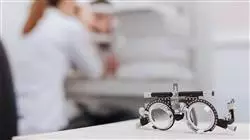
Profundizarás en los nuevos modelos de intervención optométrica aplicados al envejecimiento visual, abordando desde la detección temprana hasta la adaptación personalizada de ayudas visuales”
Syllabus
The content structure has been designed by a team of professionals who recognize the implications of training in medical practice for Low Vision and Geriatric Optometry, who are aware of the current relevance of specialization to be able to treat pediatric patients with urgent pathology, and who are committed to quality teaching through new educational technologies.

This Postgraduate certificate in Low Vision and Geriatric Optometry will help you keep up to date to provide comprehensive quality care to patients”
Module 1. Low Vision and Geriatric Optometry
1.1. Low Vision, Definition and Current Classifications
1.1.1. Definition, New Terms and Concepts
1.1.2. What Is a Low Vision Test?
1.1.3. Functional Vision
1.1.4. New Concept of Fragile Vision
1.1.5. Different Classifications, a Single Protocol?
1.1.6. Statistics Related to Visual Impairment of All Types
1.1.7. Acceptions and Terminology
1.1.8. Low Vision Statistics
1.1.9. Low Vision Decalogue
1.2. Ocular Pathologies and Other Conditions Causing Low Vision
1.2.1. Degenerative and Non-Degenerative Pathologies
1.2.2. Classification of These Pathologies According to Their Condition
1.2.3. Physiopathogenesis
1.2.4. Risk Factors
1.2.5. Current Evolution of These Pathologies, Epidemiology
1.2.6. Adjustment Process to Visual Impairment
1.2.7. Low Vision in Children and Infants
1.3. Anamnesis in Low Vision and Multidisciplinary Intervention
1.3.1. Preliminary Considerations
1.3.2. Guidelines for Interacting with Low Vision Individuals
1.3.3. Role of the Patient’s Family and/or Companions
1.3.4. How to Communicate the Information
1.3.5. Accompanying the Low Vision Individuals
1.3.6. Patient Selection, Success or Failure, Outcome Prognoses
1.4. Clinical Intervention Protocol for Low Vision Individuals or Who Suffer Moderate to Severe Visual Loss
1.4.1. WHO Diagram
1.4.2. Individuals Eligible for Low Vision Adaptive Aids and Visual Rehabilitation
1.4.3. Improved Intervention for People with Low Vision, Fragile Vision, or Neurological Injuries
1.4.4. Tips for Professionals to Help Patients and Family Members
1.4.5. Interdisciplinary Referral Protocol
1.4.6. Interaction Visually Impaired Individuals
1.4.7. Same Conditions, Different Solutions
1.5. Low Vision Consultation Material
1.5.1. Attitude and Aptitude
1.5.2. Material in Low Vision and Geriatrics
1.5.3. Tests Required for Evaluation
1.5.4. Which Commercial Products Are Useful?
1.5.5. Organizing a Low Vision Consultation
1.5.6. Patient and Family Support Reports
1.6. Low Vision and Geriatric Vision Patient Examination
1.6.1. Core Values in Caring for Low Vision and Geriatric Patients
1.6.2. Dunning-Kruger Effect in Professionals
1.6.3. Refraction in Low Vision Patients
1.6.4. Distant Vision
1.6.5. Near Vision
1.6.6. What Does the Patient Want?
1.7. Visual and Non-visual Aids in Visual Limitation, Low Vision and Geriatrics
1.7.1. Optical Aids, Classification
1.7.2. Non-Optical Aids Environment in Low Vision Patients
1.7.3. Electronic Aids, Classification and Utility
1.7.4. Latest Technologies and Artificial Intelligence for Low Vision
1.7.5. How to Create Positive Circumstances
1.8. Light, Its Importance and Basic Concepts Needed for Low Vision
1.8.1. Notions of Light Spectrum
1.8.2. Basic Concepts
1.8.3. Adaptation to Light and Darkness in Low Vision
1.8.4. Glare, a Fundamental Factor in Low Vision and Geriatrics
1.8.5. Variable of Objects Influencing Vision
1.8.6. Selective Filters: Not Everything Goes
1.9. Training in Low Vision Patient Support, Accompaniment and Follow Up
1.9.1. Optimal Choice in Patient Aids
1.9.2. Clear and Documented Information about Prescribed Aids
1.9.3. Guidelines for Training Aids
1.9.4. Specific Training in Distance, Medium and Near Vision
1.9.5. Expectations and Perceptions
1.9.6. Multidisciplinary Follow-up and Intervention, Training
1.9.7. Concepts of TR and Patient Orientation
1.10. Geriatric Optometry Aging and Vision Problems
1.10.1. Pillars of Geriatrics
1.10.2. Aging and Visual Impairment
1.10.3. Significant Physical Changes
1.10.4. Personal Autonomy Assessment
1.10.5. Most Relevant Neuropsychological Characteristics
1.10.6. Optometric Examination in Geriatric Patients
1.10.7. Appropriate Corrections in Geriatric Patients
1.10.8. Welfare Support

This training will allow you to advance in your career comfortably"
Postgraduate Certificate on Low Vision and Geriatric Optometry
Visual impairment is not a new issue, although perhaps the dimension of the problem is a little known topic. According to the WHO, in a report issued in 2021, about one third of the world's population (about 2.2 billion people) suffer from some vision deficit. Of this figure, about one thousand cases (according to WHO estimates) could either have been avoided or have not yet been treated. A large part of the total number of people affected are older adults. The Postgraduate Certificate in Low Vision and Geriatric Optometry offered by TECH Global University is an academic proposal of the highest curricular value to face this problem. It is well known that the aging process involves changes in physiological systems that alter locomotor, sensory and neuronal processing functions, which is why organs such as sight are affected. More and more people are required to deal with this aspect and the online Postgraduate Certificate we have designed guarantees you the ideal knowledge to develop with full confidence in this area so requested in the ophthalmologic world.
Become an expert on geriatric optometry
Advances in the field of eye health demand a continuous updating of the intervention processes by the graduate. The obstacle in this matter is that the academic programs offered for this purpose are generally extensive, face-to-face and with fixed schedules that leave aside any other activity that is planned to be performed. Here at TECH we offer you the possibility of training in one of the most popular areas in the visual health sector in a brief, 100% online way and with total time flexibility that allows you to carry out other activities. We also have a teaching team with remarkable experience in ophthalmology that will accompany you through ten topics, each one of them broken down in a relevant way. You will learn about the conditions that cause low vision, ocular pathologies, the correct anamnesis in geriatric patients, notions about light in relation to sight, the optometric examination and training in geriatric patients, among many other useful topics. We encourage you to study with us and expand your vision towards new horizons of excellence and high-level professional development.